Phones answered 24/7Hawkins, TX 75765
Call (281) 326-6212
(281) 326-6212

Typical jobs across Wood County

The calls we handle most often: what homeowners notice, what our technicians do, and what to expect.

  • Phones answered 24/7
  • Licensed local partner
  • Price approved before treatment
  • Written report every visit

Get a fast quote

Fastest: call (281) 326-6212. Or send this and we call you back.

6 job stories

The calls we handle most

Typical job
Illustration: Carpenter bees drilling the deck and fascia of a Lake Hawkins cabin

Carpenter bees drilling the deck and fascia of a Lake Hawkins cabin

What homeowners notice
Each spring, owners of a weekend cabin on a county road by Lake Hawkins see big, shiny black bees hovering at the deck rails and find neat round holes in the pine fascia. Little piles of sawdust collect on the boards below, with yellow stains streaking the trim.
What we do
The partner technician locates the active galleries in the fascia, rails and porch ceiling, puts a labeled dust into each hole and leaves them open for a few days so returning bees pick it up. Plugging the holes and painting or staining bare wood is advised once the drilling stops.
What to expect
New drilling usually tapers off within a couple of weeks, and the written report marks every treated hole so the owners know where to look next spring.

1 hour typical visit

Typical job
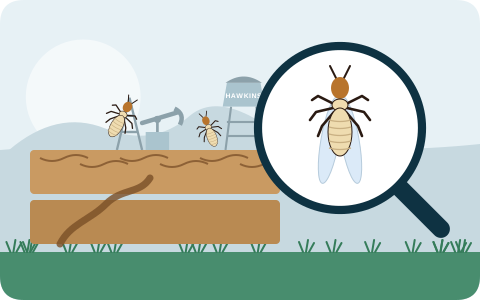
Illustration: Mud tubes on the piers of an older pier-and-beam house in Big Sandy

Mud tubes on the piers of an older pier-and-beam house in Big Sandy

What homeowners notice
While crawling under an older frame house in Big Sandy to fix a leaking pipe, a homeowner spots pencil-wide mud tubes climbing two brick piers. A spongy patch in the hallway floor above has them wondering how long termites have been at work.
What we do
The technician crawls the whole space, probes sill plates and joists, checks the skirting, plumbing runs and a back porch where wood meets dirt, and confirms eastern subterranean termites. Liquid soil treatment and a bait system are both priced up front, along with the damp spots and wood contact worth fixing.
What to expect
The homeowner chooses a treatment with the price already approved, and the report pins down each pier and wall where tubes or damage turned up, which helps later if the house is sold.

90 minutes typical visit

Typical job
Illustration: Lone star ticks on wooded pasture land near Hainesville

Lone star ticks on wooded pasture land near Hainesville

What homeowners notice
On a few acres of pasture and post oak off FM 49, the dogs come in carrying ticks almost every day from spring into early summer, and so does anyone who walks the fence line. Most are lone star ticks, picked up along the brushy edge where the woods meet the grass.
What we do
The technician walks the place to find where ticks bunch up, then treats the woods edge, tall grass along fences, the dog run and the shady yard around the house according to the label. Mowing a wider buffer and clearing brush piles is recommended, and pets are pointed to the vet for tick prevention.
What to expect
Tick pickups typically fall off in the treated zones over the next few weeks, and the report notes when a follow-up makes sense as the season wears on.

2 hours typical visit

Typical job
Illustration: Fire ant mounds popping up across a Holly Lake Ranch yard after rain

Fire ant mounds popping up across a Holly Lake Ranch yard after rain

What homeowners notice
A day after a soaking fall rain, a homeowner in Holly Lake Ranch counts a dozen fresh fire ant mounds in the lawn, along the driveway and against the AC unit's pad. One sits right next to the swing set where the grandkids play.
What we do
Using Texas A&M AgriLife's Two-Step Method, the technician broadcasts fire ant bait over the lawn, then treats the mounds nearest the house, the AC pad and the play area. Before leaving, the technician explains how long to keep pets and children off the treated areas.
What to expect
Mounds typically fade over the following weeks as workers carry the bait down to the queens, and the report notes that a spring round helps hold them down next year.

45 minutes typical visit

Typical job
Illustration: Mice in the feed room and metal shop on a property near Winona

Mice in the feed room and metal shop on a property near Winona

What homeowners notice
Soon after the first cold front of fall, a landowner near Winona finds chewed feed sacks, droppings across the shop workbench and a nest tucked into a stored mower's seat. Wiring under the hood of a parked truck has been gnawed as well.
What we do
The technician walks the barn, feed room and shop, sets traps along walls, shelves and rafters, and closes gaps at door bottoms, pipe openings and the base of the metal siding using galvanized mesh and metal flashing. Moving feed into lidded metal cans is recommended to cut off the food supply.
What to expect
Catches usually drop within a few weeks as the sealed openings keep new mice from moving in, and every follow-up check is recorded on the written report.

2–3 hours typical visit

Typical job
Illustration: Paper wasp nests under the porch ceiling of a Lindale home

Paper wasp nests under the porch ceiling of a Lindale home

What homeowners notice
By midsummer, a Lindale family can't sit on the front porch without being buzzed. Three paper wasp nests hang from the porch ceiling, another is wedged into the light fixture by the door, and someone has already been stung.
What we do
The technician treats each nest with a labeled product, knocks down and bags the combs, then checks the eaves, porch rail and backyard shed for nests nobody has noticed yet. Gaps in the soffit where wasps tend to start over are pointed out for sealing.
What to expect
In most cases the porch is usable again the same day, and the report lists every nest removed plus the spots to watch when wasps return next spring.

45 minutes typical visit

Have the same problem?

Call and tell us what you see. We will tell you what it likely is and what it usually costs before anyone drives out.

Find Hawkins Pest Control on